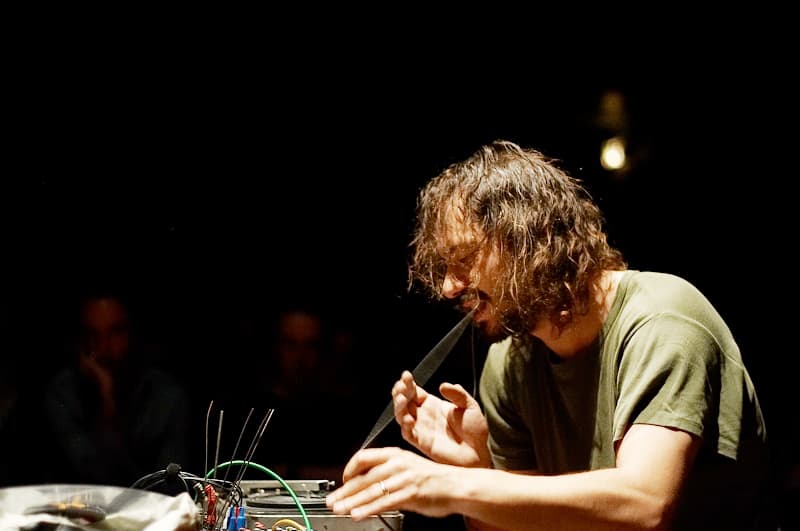
AUTOREVERSE-ph.-Massimo-Golfieri.jpg&w=3840&q=75&dpl=dpl_9eoUrAS4DcnvtCnNz5KE8Dm1z79m)
Paris-based duo AUTOREVERSE, bringing together electric guitar, feedback, amplified scrap metal and provoked chance in a music as immediate as it is incandescent.
Formed in 2020 by Nina Garcia and Arnaud Rivière, AUTOREVERSE operate somewhere between improvisation and noise: constructed and cracked matter, rhythmic sketches, fleeting melodies and high-energy bursts of sound.
Support to be announced soon.
Arnaud’s performance is far from subtle. He will attack you with raw sounds of objects rotating on the turntable and dangerous wires stuck directly into his mixer. His sonic intervention is ecstatic but he is also detached enough to hint at sarcasm moments before he moves on to destroy another objects for auditory pleasure. For me, Arnaud is an important turntablist that extends the practices of Yoshihide Otomo and Martin Tetreault, where the raw sound of the material overwhelms any sort of reference or functionality that the medium was originally intended to have.
He is an unabashed feedbackophile who creates monstrous gusts of noise with simple tools used incorrectly. Jamming foreign objects and wires into his mixing board, using his turntable to spin metal disks or worse, twisting his distortion pedal to 11, the harsh beauty of Riviere’s music does not come from conventional concepts like melody and harmony, but from deftly controlled bursts of energy, powerful gestures of thunderous layers of noise upon noise, and a wonderful sense of structure.
Since 2015, Nina Garcia has been researching and creating around the electric guitar, halfway between improvised music and noise. Her set-up is reduced to a minimum: a guitar, a pedal, and an amp with which she sculpts sound and delves into chaos to bring out the unheard-of. Her concerts draw audiences into an immersive sonic space where power and fragility intersect with communicative intensity. In just a few years, she has attracted the attention of numerous international stages.
Nina Garcia presents a new work with a magnifying glass where the guitar is amplified by 1-inch zones. A fist linked to a micro-microphone, « ultra-territorial » music and total dependence of the sound on the slightest movement. What emerges from this new research is a tenfold increase in tension, forced silences, aborted feedback, and manufactured loops that are always trying to move forward. Her music is increasingly handmade, but always with a high intensity. In this new set we find her classical Mariachi folklore: threaded rods, saturated wedding and funeral noises, assertive rhythms and breaks, and a privileged link with the amp as a playing partner.